All content on this site is intended for healthcare professionals only. By acknowledging this message and accessing the information on this website you are confirming that you are a healthcare professional. If you are a patient or carer, please visit the Lymphoma Coalition.
The Lymphoma Hub website uses a third-party service provided by Google that dynamically translates web content. Translations are machine generated, so may not be an exact or complete translation, and the Lymphoma Hub cannot guarantee the accuracy of translated content. The Lymphoma Hub and its employees will not be liable for any direct, indirect, or consequential damages (even if foreseeable) resulting from use of the Google Translate feature. For further support with Google Translate, visit Google Translate Help.


The Lymphoma & CLL Hub is an independent medical education platform, sponsored by AbbVie, BeOne Medicines, Miltenyi Biomedicine, Nurix Therapeutics, Roche, Sobi, and Thermo Fisher Scientific and supported through educational grants from Bristol Myers Squibb, Eli Lilly, and Pfizer. Funders are allowed no direct influence on our content. The levels of sponsorship listed are reflective of the amount of funding given. View funders.
Now you can support HCPs in making informed decisions for their patients
Your contribution helps us continuously deliver expertly curated content to HCPs worldwide. You will also have the opportunity to make a content suggestion for consideration and receive updates on the impact contributions are making to our content.
Find out more
Create an account and access these new features:
Bookmark content to read later
Select your specific areas of interest
View lymphoma & CLL content recommended for you
AACR 2017 | Poster 4051/21 – Combination efficacy of vorinostat (HDAC inhibitor) and palbociclib (CDK-4/6 dual inhibitor) against therapy-resistant Mantle Cell Lymphoma
At the American Association for Cancer Research (AACR) annual meeting in Washington, DC, USA, on Tuesday 4th April, a poster session titled “Combination Therapies and Approaches to Sensitize Cancer Cells to Drugs” took place.
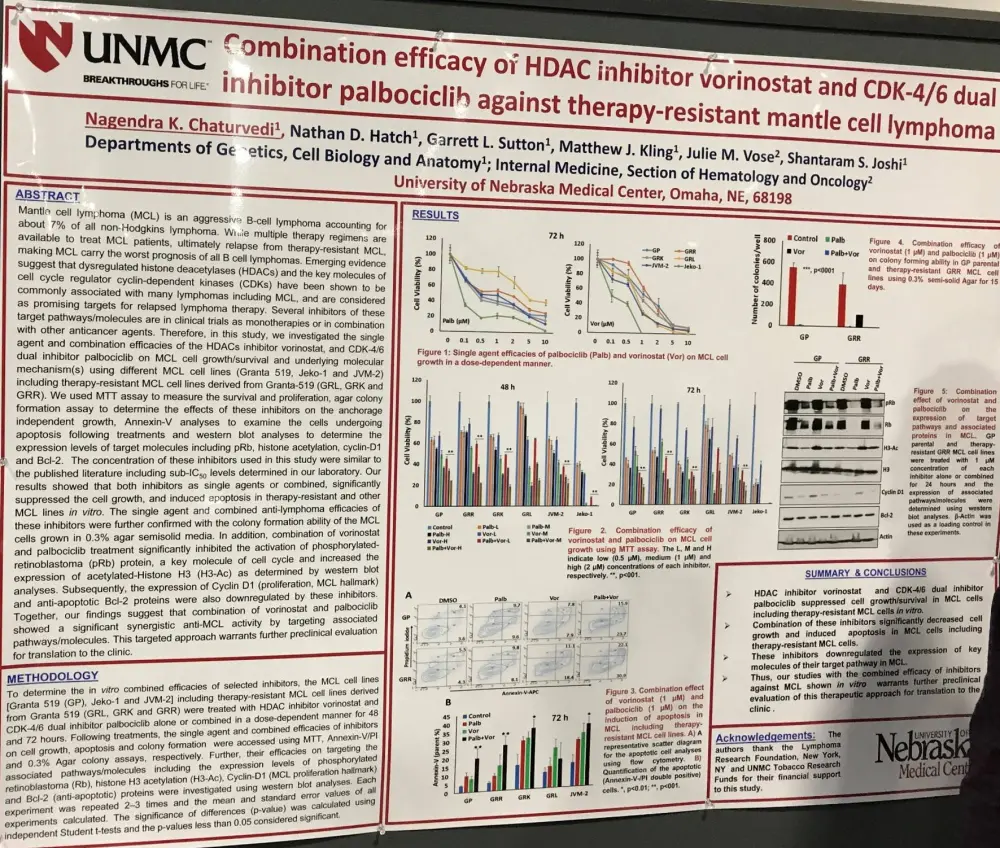
One of the posters on display (4051 / 21) was titled “Combination efficacy of HDAC inhibitor vorinostat and CDK-4/6 dual inhibitor palbociclib against therapy-resistant mantle cell lymphoma” by Nagendra K. Chaturvedi from the University of Nebraska Medical Center, Omaha, NE, and colleagues.
This group analyzed the efficacy of vorinostat as a single agent and in combination with palbociclib on MCL cell growth, survival, and underlying molecular mechanism(s) using different cell lines (Granta 519, Jeko-1, and JVM-2). Therapy-resistant MCL cell lines were also used, derived from Granta-519 (GRL, GRK, and GRR).
Key Highlights:
- Both vorinostat and palbociclib, as single agents or combined, significantly suppressed cell growth and induced apoptosis in therapy-resistant and other MCL lines
- Combining vorinostat and palbociclib significantly inhibited the activation of phosphorylated-retinoblastoma protein (a key component of cell cycle regulation) and increased expression of acetylated-Histone H3
- Expression of Cyclin D1 and Bcl-2 proteins were downregulated by these inhibitors
The poster concluded by stating that these results indicate that combination of vorinostat and palbociclib demonstrated significant synergistic activity in MCL by targeting associated pathways/molecules. The authors stressed that this combination should be evaluated in further preclinical studies in order for translation to the clinic.
References
Please indicate your level of agreement with the following statements:
The content was clear and easy to understand
The content addressed the learning objectives
The content was relevant to my practice
I will change my clinical practice as a result of this content
Your opinion matters
In your experience, what is the average vein-to-vein time when treating patients with DLBCL with a reimbursed CAR T-cell therapy (from apheresis to infusion)?