All content on this site is intended for healthcare professionals only. By acknowledging this message and accessing the information on this website you are confirming that you are a healthcare professional. If you are a patient or carer, please visit the Lymphoma Coalition.
The Lymphoma Hub website uses a third-party service provided by Google that dynamically translates web content. Translations are machine generated, so may not be an exact or complete translation, and the Lymphoma Hub cannot guarantee the accuracy of translated content. The Lymphoma Hub and its employees will not be liable for any direct, indirect, or consequential damages (even if foreseeable) resulting from use of the Google Translate feature. For further support with Google Translate, visit Google Translate Help.


The Lymphoma Hub is an independent medical education platform, sponsored by Roche, AbbVie, BeOne, Miltenyi Biomedicine, Thermo Fisher, Nurix Therapeutics and Caribou Biosciences and supported through independent educational grants from Incyte, Bristol Myers Squibb, Pfizer and Takeda Pharmaceuticals U.S.A., Inc. Funders are allowed no direct influence on our content. The levels of sponsorship listed are reflective of the amount of funding given. View funders.
Now you can support HCPs in making informed decisions for their patients
Your contribution helps us continuously deliver expertly curated content to HCPs worldwide. You will also have the opportunity to make a content suggestion for consideration and receive updates on the impact contributions are making to our content.
Find out more
Create an account to access:
Bookmark & personalize site content
Receive alerts for new content in your areas of interest
View lymphoma & CLL content recommended for you
EORTC-1537-COBRA phase II: Very early PET-guided therapy in advanced-stage cHL
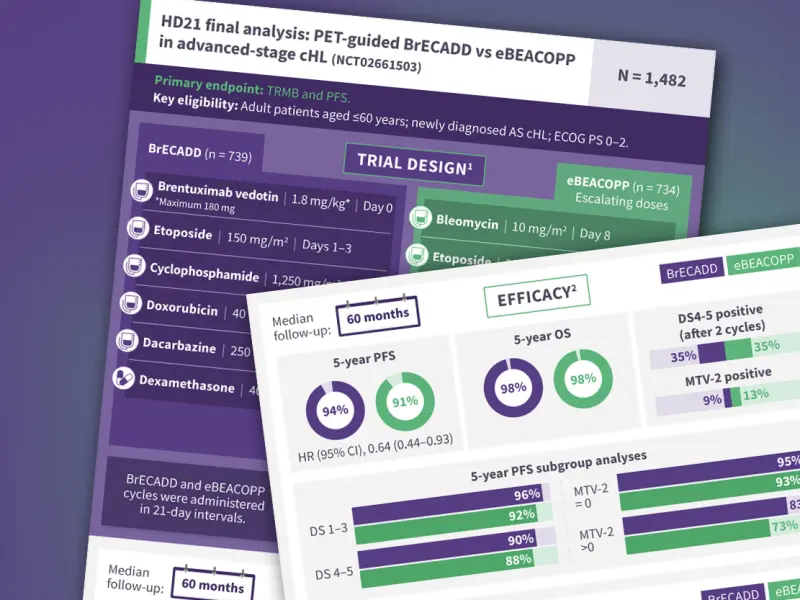
Primary results from the single-arm, multicenter, phase II EORTC-1537-COBRA trial (NCT03517137) evaluating very early [18F]fluorodeoxyglucose positron emission tomography–computed tomography ([18F]FDG-PET–CT)-guided treatment adaptation in adults with previously untreated, advanced-stage classical Hodgkin lymphoma (cHL), were published in The Lancet Haematology by Hutchings et al. Following one cycle of brentuximab vedotin + doxorubicin + vinblastine + dacarbazine (A-AVD), PET1-negative patients (n = 90; 60%) continued A-AVD, while PET1-positive patients (n = 60; 40%) switched to brentuximab vedotin + etoposide + cyclophosphamide + doxorubicin + dacarbazine + dexamethasone (BrECADD). The primary endpoint was 2-year modified progression-free survival (mPFS) in evaluable patients (n = 145).
Key data: At a median follow-up of 30.1 months, the 2-year mPFS was 89.5% (80% confidence interval [CI], 85.7–92.4), meeting the predefined success criterion; 2-year overall survival (OS) was 100%. By PET1 status, 2-year mPFS was 88.3% (95% CI, 79.4–93.5) with continued A-AVD and 91.3% (95% CI, 80.3–96.3) following switch to BrECADD. Positive serum thymus and activation-regulated chemokine (sTARC) after one cycle was associated with PET1 positivity (odds ratio [OR], 2.3; 95% CI, 1.0–5.2; p = 0.048). Grade 3–4 adverse events (AEs) occurred in 63%, most commonly neutropenia (35%) and anemia (12%); serious AEs occurred in 30%, with no treatment-related deaths.
Key learning: Very early PET-guided intensification to BrECADD achieved high clinical activity in advanced-stage cHL while sparing most patients intensive chemotherapy.
References
Please indicate your level of agreement with the following statements:
The content was clear and easy to understand
The content addressed the learning objectives
The content was relevant to my practice
I will change my clinical practice as a result of this content
This content is accurate as of the date of publication and is not updated retrospectively. Please refer to the latest available evidence, guidelines, and relevant regulatory information when making clinical decisions.
Your opinion matters
When selecting the next therapy for patients with R/R MCL after BTKi progression, what is your most important consideration?