All content on this site is intended for healthcare professionals only. By acknowledging this message and accessing the information on this website you are confirming that you are a healthcare professional. If you are a patient or carer, please visit the Lymphoma Coalition.
The Lymphoma Hub website uses a third-party service provided by Google that dynamically translates web content. Translations are machine generated, so may not be an exact or complete translation, and the Lymphoma Hub cannot guarantee the accuracy of translated content. The Lymphoma Hub and its employees will not be liable for any direct, indirect, or consequential damages (even if foreseeable) resulting from use of the Google Translate feature. For further support with Google Translate, visit Google Translate Help.


The Lymphoma Hub is an independent medical education platform, sponsored by Roche, AbbVie, BeOne, Miltenyi Biomedicine, Thermo Fisher, Nurix Therapeutics and Caribou Biosciences and supported through independent educational grants from Incyte, Bristol Myers Squibb, Pfizer and Takeda Pharmaceuticals U.S.A., Inc. Funders are allowed no direct influence on our content. The levels of sponsorship listed are reflective of the amount of funding given. View funders.
Now you can support HCPs in making informed decisions for their patients
Your contribution helps us continuously deliver expertly curated content to HCPs worldwide. You will also have the opportunity to make a content suggestion for consideration and receive updates on the impact contributions are making to our content.
Find out more
Create an account to access:
Bookmark & personalize site content
Receive alerts for new content in your areas of interest
View lymphoma & CLL content recommended for you
Symposium | BTK inhibitors in CLL: Mechanisms, clinical considerations, and unmet needs
Featured:
 Susan O'Brien
Do you know... Which characteristic of non-covalent BTK inhibitors allows them to retain activity in patients with CLL who harbor a BTK C481 mutation?
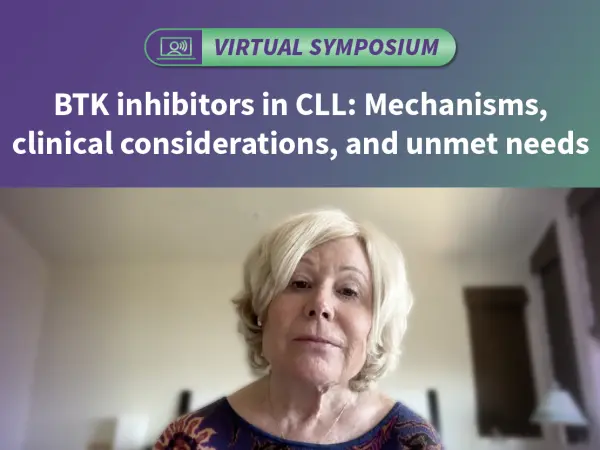
On June 22, 2026, the Lymphoma Hub held a virtual symposium, titled Optimizing treatment for chronic lymphocytic leukemia with BTK inhibitors. During the symposium, Lymphoma Hub Steering Committee member Susan O’Brien, University of California Irvine, US, delivered a presentation on BTK inhibitors in chronic lymphocytic leukemia: Mechanisms, clinical considerations, and unmet needs.
Symposium | BTK inhibitors in CLL: Mechanisms, clinical considerations, and unmet needs
Symposium | BTK inhibitors in CLL: Mechanisms, clinical considerations, and unmet needs
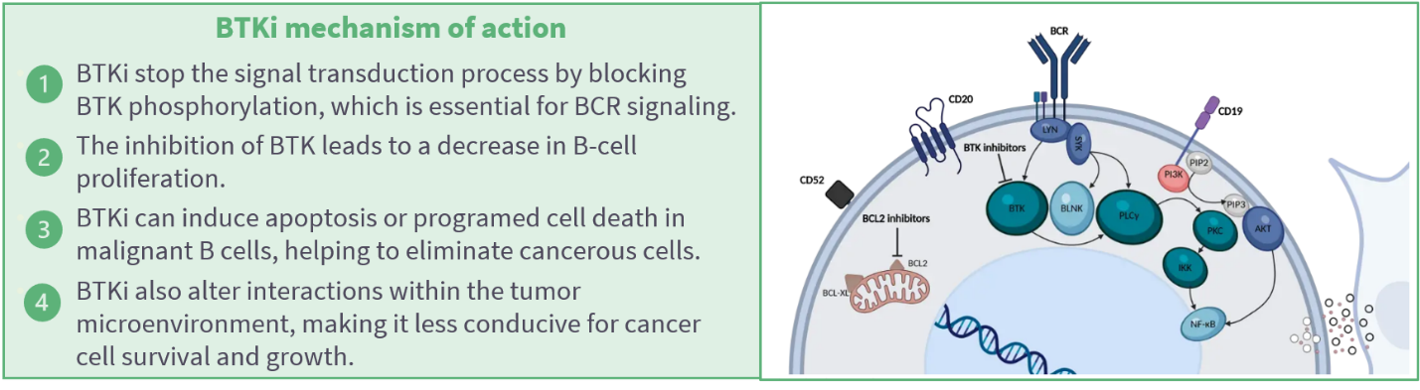
During her presentation, O’Brien provides an overview of the discovery of Bruton’s tyrosine kinase (BTK) as a target in chronic lymphocytic leukemia (CLL), the early clinical development of BTK inhibitors (BTKis), their mechanism of action (Figure 1), and how they impacted the treatment paradigm in patients with CLL. O’Brien discusses the off-target effects of BTKis and how their selectivity impacts their safety profile, the importance of evaluating clinical factors when selecting treatment, and the long-term tolerability of and resistance to BTKis. Finally, O’Brien highlights the persistent unmet needs in patients with CLL treated with a BTKi.
Figure 1. BTKi mechanism of action in CLL*
Key points
- Increased understanding of the role of B-cell receptor (BCR) signaling in CLL pathogenesis has led to the development of targeted therapies, such as BTKis.2
- Targeting BTK has transformed the management of patients with CLL; treatment with BTKis has significantly improved outcomes compared with traditional chemoimmunotherapy.3,4
- While ibrutinib established BTK as a key therapeutic target in CLL, off-target effects associated with ibrutinib led to the development of more selective second-generation covalent BTKis, such as acalabrutinib and zanubrutinib, and non-covalent BTKis, such as pirtobrutinib.5,6
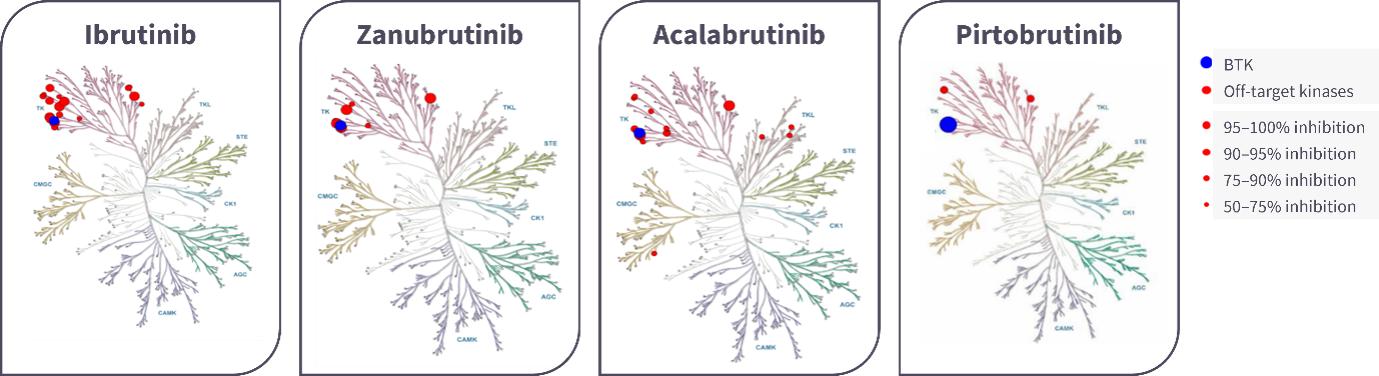
- In a study of 370 kinases, ibrutinib inhibited more off-target kinases (≥50%) vs acalabrutinib and zanubrutinib when tested at 100× their half-maximal inhibitory concentration (Figure 2).7
- Pirtobrutinib is a highly selective non-covalent BTKi that inhibits fewer off-target kinases vs covalent BTKis, which may contribute to an improved safety profile (Figure 2).8,9
- The safety profiles of BTKis are closely linked to their kinase-binding patterns; BTKis are associated with an increased risk of cardiovascular toxicities, including atrial fibrillation and hypertension, and the careful evaluation of clinical factors, such as pre-existing comorbidities, is necessary.4
- Real-world retrospective studies have demonstrated that toxicities are a major cause of treatment discontinuation in patients receiving covalent BTKis.10,11
- Resistance to BTKis remains a major clinical challenge, resulting in treatment failure and disease progression for a significant portion of patients.12
- Several factors contribute to BTKi resistance, including genetic mutations, chromosomal aberrations, dysregulation of protein expression, tumor microenvironment, and metabolic reprogramming.13
- BTK C481 mutations prevent covalent BTKi binding and are the predominant mechanism of acquired resistance to covalent BTKis in patients with CLL.12
- Pirtobrutinib binds to BTK within the ATP-binding pocket of BTK at a location that is spatially distinct from the C481 residue, resulting in inhibitory activity even when mutations at C481 prevent covalent bond formation, addressing an unmet need in patients who are resistant to covalent BTKis.14,15
- O’Brien concludes by highlighting persistent unmet needs in the CLL treatment landscape, including:
- BTKi discontinuation due to toxicity or progression16
- Acquired resistance to BTKis17
- Lack of clearly defined optimal sequencing strategies17
- Limited treatment options for BTKi-refractory patients17
- Standardization and clinical validation of measurable residual disease as an actionable biomarker18,19
- More durable, disease-modifying treatments for patients with high-risk CLL20
Figure 2. Kinase selectivity of ibrutinib, acalabrutinib, zanubrutinib, and pirtobrutinib*
This educational resource is independently supported by Eli Lilly. All content is developed by SES in collaboration with an expert steering committee. Funders are allowed no influence
References
Please indicate your level of agreement with the following statements:
The content was clear and easy to understand
The content addressed the learning objectives
The content was relevant to my practice
I will change my clinical practice as a result of this content
This content is accurate as of the date of publication and is not updated retrospectively. Please refer to the latest available evidence, guidelines, and relevant regulatory information when making clinical decisions.
More from this series:
Symposium | Optimizing treatment for chronic lymphocytic leukemia with BTK inhibitors


Your opinion matters
When selecting the next therapy for patients with R/R MCL after BTKi progression, what is your most important consideration?